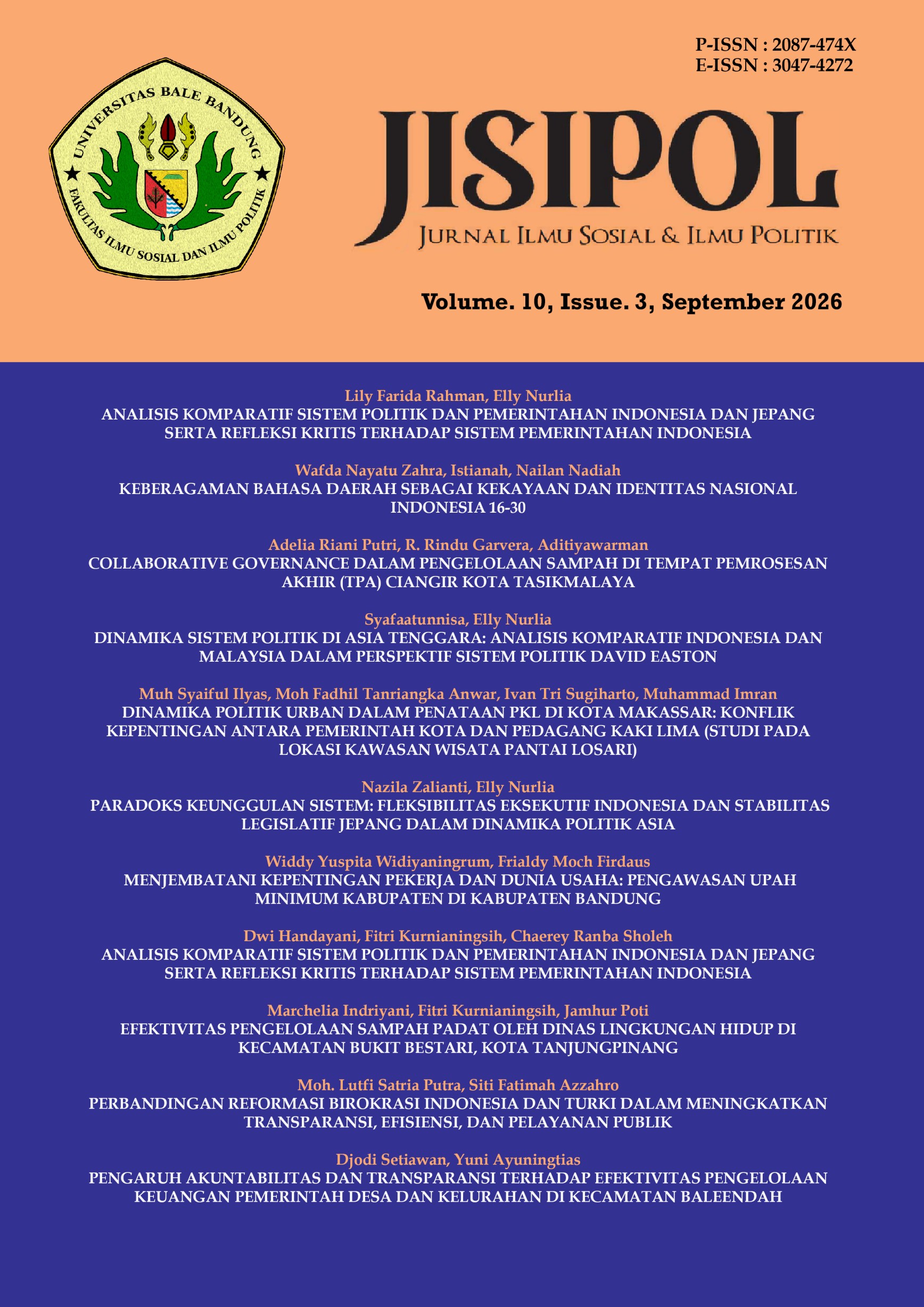
Urban Political Dynamics in the Management of Street Vendors in Makassar: A Conflict of Interests Between the City Government and Street Vendors (A Study of the Losari Beach Tourist Area)
Keywords:
Politik Urban, Konflik Kepentingan, Pedagang Kaki Lima, Kota MakassarAbstract
This study analyses the dynamics of urban politics in the regulation of street vendors (PKL)
in the Losari Beach tourist area of Makassar City, which has become an arena for conflicting
interests between the city government and the informal economy. Using a qualitative
approach with a case study design, this study explores regulations, street vendor responses,
and government solutions through semi-structured interviews with street vendors, the
Public Order Agency, the Tourism Office, the Cooperatives and MSMEs Office, and field
observations. The analysis utilizes Thomas R. Dye's public policy theory and Lewis A.
Coser's social conflict theory. This paper shows that Regional Regulation No. 7 of 2021 and
Mayoral Regulation No. 29 of 2018 serve as the basis for regulating and relocating street
vendors, but their implementation is dominated by a top-down and repressive approach that
prioritizes urban aesthetics and the image of the tourist area over the vendors' economic
sustainability. Street vendor resistance does not emerge as pure defiance, but rather an
economic adaptation strategy due to the unstrategic relocation location and declining
income, manifested through clandestine selling practices or returning to old locations.
Government solutions such as shift systems, relocation, and empowerment of MSMEs have
been ineffective due to minimal vendor participation in policy planning and the gap between
policy design and socio-economic realities. This study concludes that conflicts over street
vendor management reflect an imbalance in power relations in the management of urban
public spaces. Therefore, policies that focus solely on visual order without integrating the
sustainability of street vendor livelihoods will continue to trigger recurring social resistance
Downloads
Published
Issue
Section
License
Copyright (c) 2026 Muh Syaiful Ilyas, Moh Fadhil Tanriangka Anwar, Ivan Tri Sugiharto, Muhammad Imran

This work is licensed under a Creative Commons Attribution-ShareAlike 4.0 International License.