Vol. 10 No. 3 (2026): Vol. 10 No. 3 (2026): Jurnal JISIPOL September 2026

					View Vol. 10 No. 3 (2026): Vol. 10 No. 3 (2026): Jurnal JISIPOL September 2026

Praise be to Allah Subhanahu wa Ta’ala for His blessings and grace, which have enabled the Journal of Social and Political Sciences (JISIPOL) Volume 10 Number 3, 2026 to be published again in September 2026. The publication of this edition represents the editorial board’s continued commitment to providing an academic platform for the development of social and political studies that are critical, contextual, and responsive to various dynamics in governance, politics, public policy, and social life.

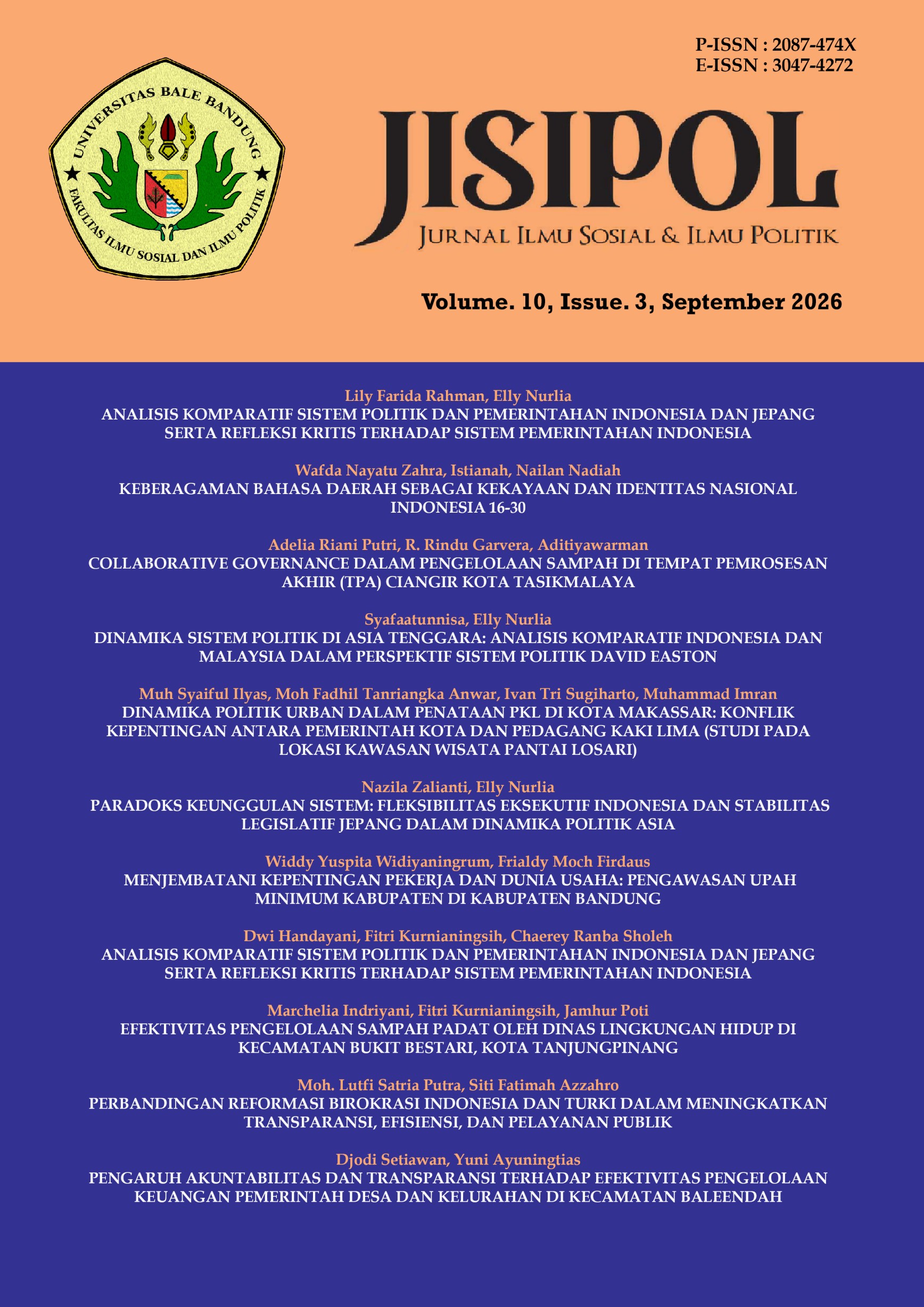
In its third edition of 2026, JISIPOL presents eleven scholarly articles that demonstrate the diversity of issues and approaches within the fields of social and political sciences. The articles address a broad range of topics, including comparative political and governmental systems of Indonesia and Japan, regional language diversity as a national identity, collaborative governance in waste management, the dynamics of political systems in Indonesia and Malaysia, and urban politics in the regulation of street vendors in Makassar. This edition also features studies on political dynamics in Asia, the relationship between workers’ and business interests in minimum wage supervision, the effectiveness of solid waste management, bureaucratic reform in Indonesia and Türkiye, as well as accountability and transparency in the financial management of villages and urban administrative areas.

The diversity of themes presented in this edition demonstrates that issues of governance and politics cannot be understood from a single perspective. Comparative studies of political systems, for instance, provide opportunities to examine how institutions, power relations, and governmental mechanisms develop within different contexts. At the same time, studies on regional languages, environmental management, urban spatial arrangements, labor, bureaucratic reform, and public financial governance illustrate the close relationship between government policies and the everyday realities of society. These studies further contribute to the broader discourse on how public institutions respond to social change and the evolving demands of society.

The editorial board recognizes that scholarly publication plays an important role in connecting theoretical frameworks with empirical realities. Accordingly, JISIPOL continues to encourage research that not only contributes to the development of concepts and theories in the social and political sciences but also provides deeper understanding of contemporary issues in governance and society. The participation of authors from diverse institutional backgrounds in this edition reflects our continuing efforts to foster an academic environment that is open, collaborative, and inclusive.

The publication of this journal would not have been possible without the contributions of various parties. The editorial board extends its sincere appreciation and gratitude to all authors, reviewers, editors, journal managers, and other contributors who have devoted their time, ideas, and efforts throughout the publication process. Each article presented in this edition is part of an academic process involving critical review, editorial refinement, and scholarly evaluation to maintain the quality of the publication and sustain the development of academic traditions within JISIPOL.

Finally, JISIPOL Volume 10 Number 3, 2026 is expected to contribute to the advancement of knowledge in the social and political sciences and to serve as a valuable reference for academics, researchers, students, government practitioners, and policymakers. More than a collection of scholarly articles, this edition is intended to provide a space for reflection and intellectual exchange in understanding the evolving social, political, and governmental issues of contemporary society.

Baleendah, September 2026

Editor-in-Chief

Published: 2026-09-24

Articles