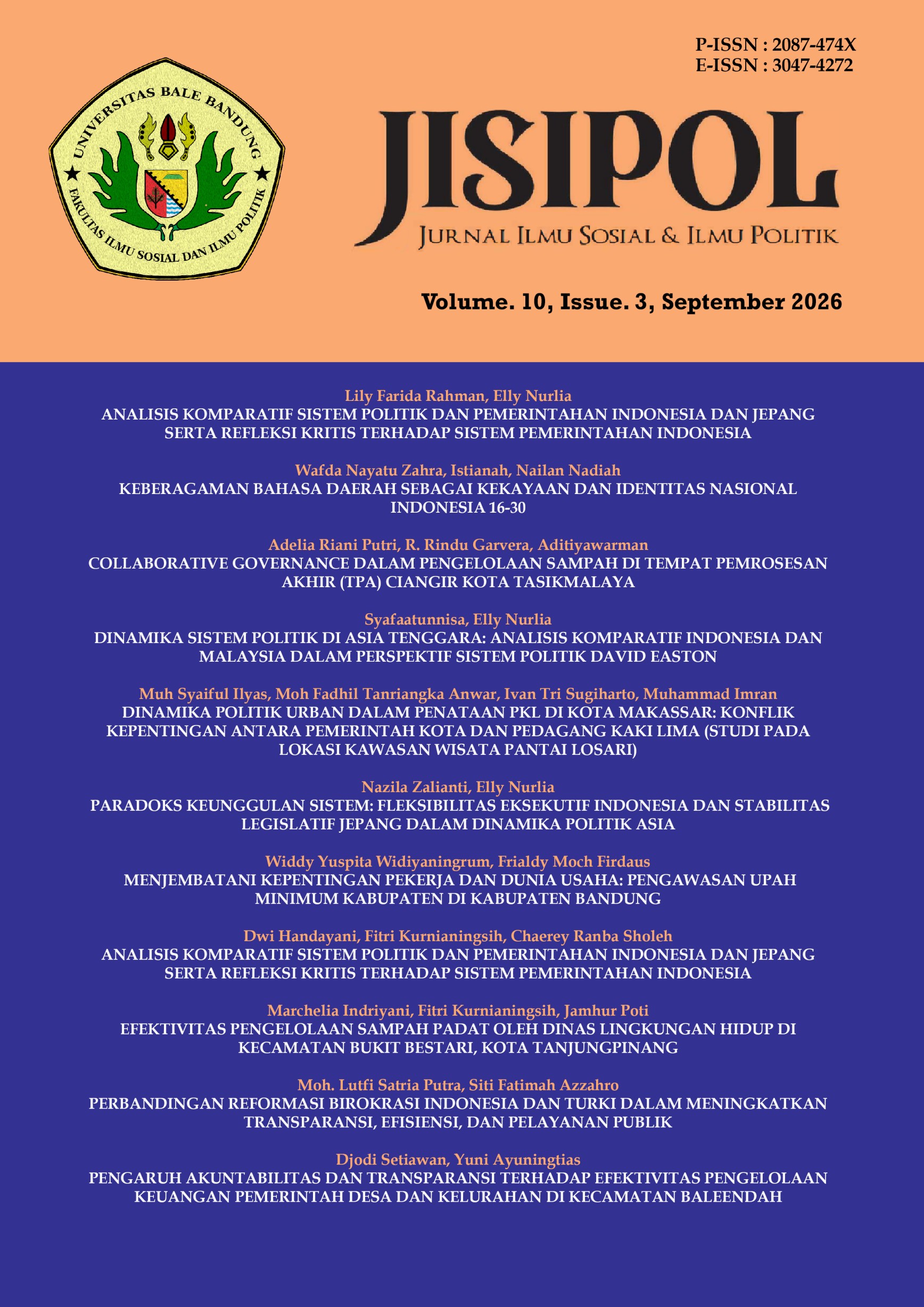
The Dynamics of Political Systems in Southeast Asia: A Comparative Analysis of Indonesia and Malaysia from the Perspective of David Easton’s Political System Theory
Keywords:
politik komparatif, sistem politik, efektivitas kebijakan, David EastonAbstract
The debate over the efficiency of presidential and parliamentary systems is generally driven by
normative assumptions that do not necessarily align with empirical reality. This study aims
to compare the influence of the political systems in Indonesia and Malaysia on the state’s
response to public demands and on the formulation of effective policies. This is a qualitative
study. Using a qualitative approach based on a literature review and David Easton’s political
system theory framework, this study examines the relationship between inputs (demands and
support), the conversion process, and policy outputs in both countries. The results show that
Indonesia, with its relatively open presidential system, has a high level of political participation
but risks experiencing an overload that affects the complexity of decision-making and policy
inconsistency. Conversely, Malaysia demonstrates efficiency in the policy conversion process
through a more consolidated parliamentary system, but with limitations in the inclusivity of
political participation. This study affirms that the effectiveness of a political system is not
solely determined by institutional design, but rather by the interaction between historical
factors, elite dynamics, social structures, and institutional capacity. These findings contribute
to enriching the field of comparative politics by challenging institutional determinism and
emphasizing the importance of strengthening institutional capacity and the quality of
substantive political representation.
Downloads
Published
Issue
Section
License
Copyright (c) 2026 Syafaatunnisa, Elly Nurlia

This work is licensed under a Creative Commons Attribution-ShareAlike 4.0 International License.