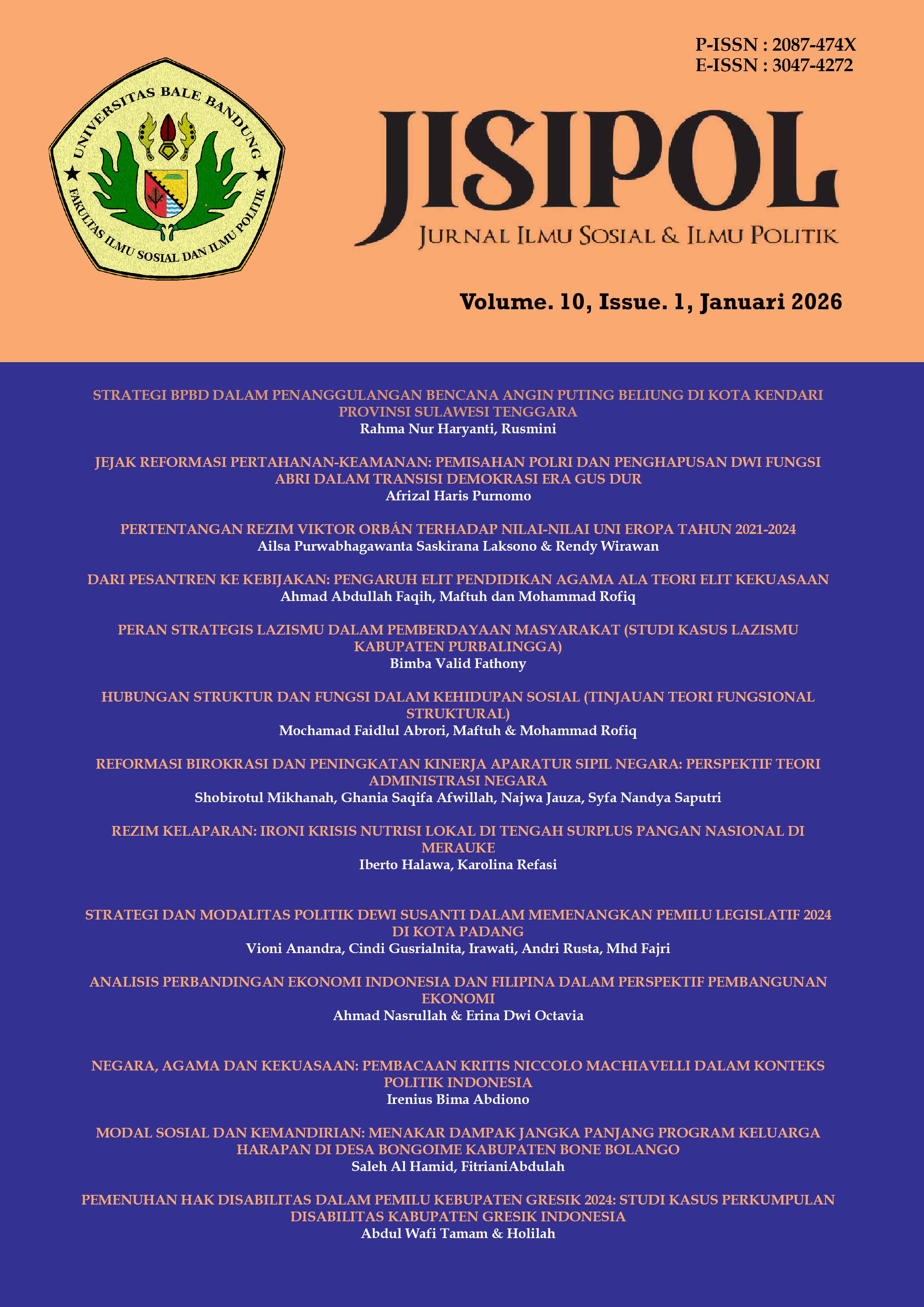
FROM ISLAMIC BOARDING SCHOOLS TO POLICY: THE INFLUENCE OF RELIGIOUS EDUCATION ELITES IN POWER ELITE THEORY
Keywords:
religious education elite, socio-religious policy, power elite theory, symbolic capital, religious educational institutionsAbstract
This study aims to analyze the position and mechanisms of influence of religious education elites in the formulation of socio-religious policies through the perspective of power elite theory. The research method employs library research with a qualitative approach, analyzing academic literature through content analysis and thematic analysis techniques. The findings indicate that religious education elites constitute a distinctive category of power elite whose influence is based on symbolic and cultural capital, rather than control over coercive apparatus or material resources. Three mechanisms of influence are identified: formal consultative channels, informal cultural influence, and institutional networks. Religious educational institutions such as pesantren, madrasah, and Islamic higher education institutions function as spaces for elite reproduction that generate cultural, social, and symbolic capital that can be converted into political influence. The influence of religious education elites demonstrates ambivalence: it can contribute positively to social stability but also has the potential to produce exclusive policies if not balanced by adequate checks and balances mechanisms. These findings extend classical power elite theory by integrating the religious dimension and Bourdieu's concept of symbolic power.
Downloads
Published
Issue
Section
License
Copyright (c) 2026 Ahmad Abdullah, Maftuh , Mohammad Rofiq

This work is licensed under a Creative Commons Attribution-ShareAlike 4.0 International License.