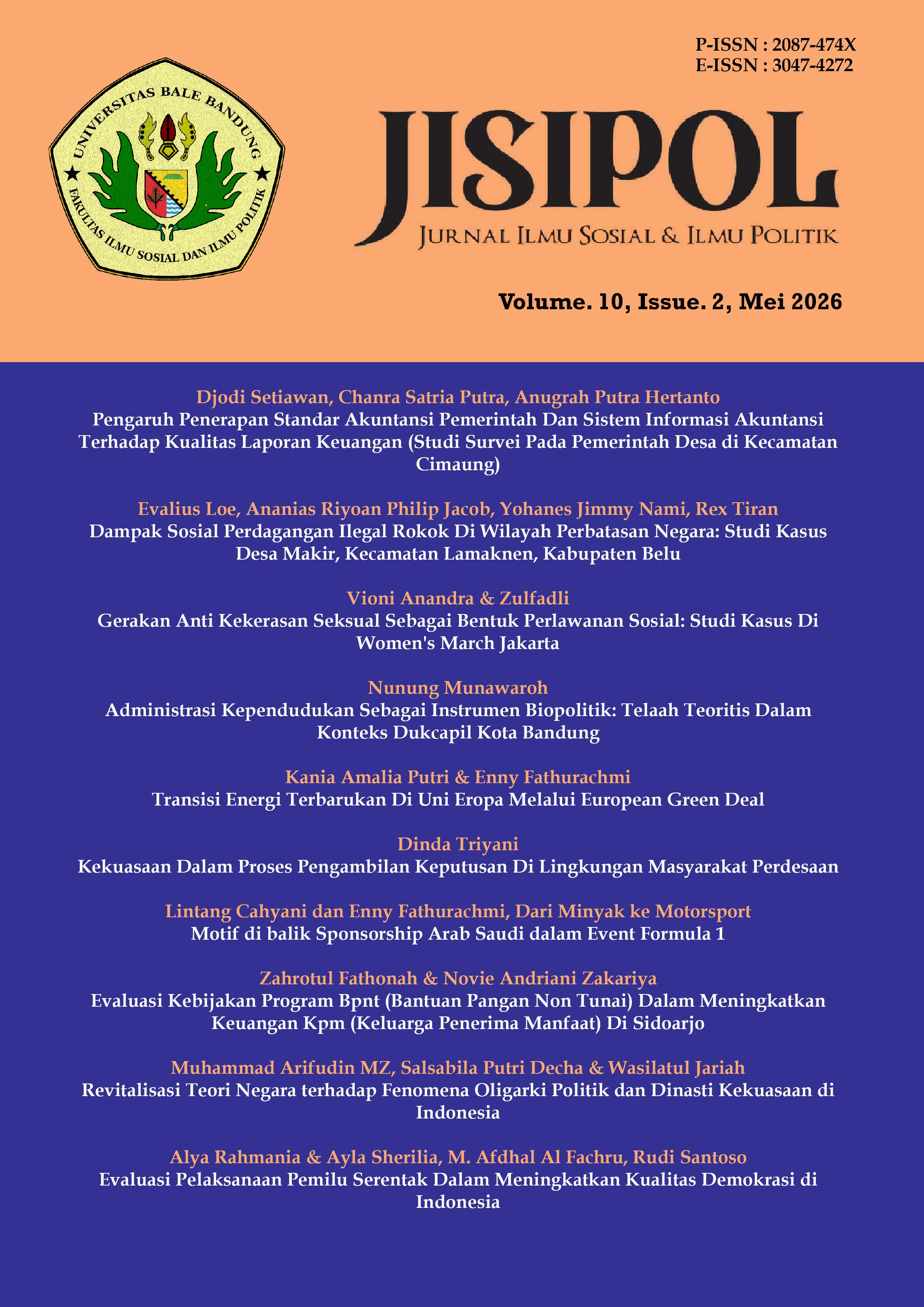
POPULATION ADMINISTRATION AS A BIOPOLITICAL INSTRUMENT: A THEORETICAL ANALYSIS IN THE CONTEXT OF THE BANDUNG CITY POPULATION AND CIVIL REGISTRATION OFFICE
Keywords:
biopolitics, population administration, DUKCAPIL, governmentality, smart cityAbstract
This study aims to analyze population administration as an instrument of biopolitics in the context of the Department of Population and Civil Registration (DUKCAPIL) of Bandung City. The research employs a qualitative approach using a library research method through conceptual and critical analysis of Michel Foucault’s theory of biopolitics, governmentality, and literature on population administration and digital governance. The findings reveal that population administration no longer functions merely as a technical administrative mechanism, but also as a technology of power that manages population life through classification, registration, normalization, and data integration processes. Through the implementation of the National Identification Number (NIK), electronic identity cards (KTP-el), and integrated digital systems, the state constructs a new relationship with citizens based on data validity and access to public services. In the context of Bandung as a smart city, the digitalization of DUKCAPIL strengthens practices of governmentality, where citizens voluntarily conform to administrative standards in order to gain recognition and access to social rights. The study also finds that citizenship has shifted from a legal status into a data-based administrative construction, creating risks of exclusion for individuals who are unregistered or invalidated within the system. Therefore, digital population administration represents a contemporary form of biopolitics that operates subtly yet effectively in shaping citizen subjectivity and expanding state control over the population.
Downloads
Published
Issue
Section
License
Copyright (c) 2026 Nunung Munawaroh

This work is licensed under a Creative Commons Attribution-ShareAlike 4.0 International License.