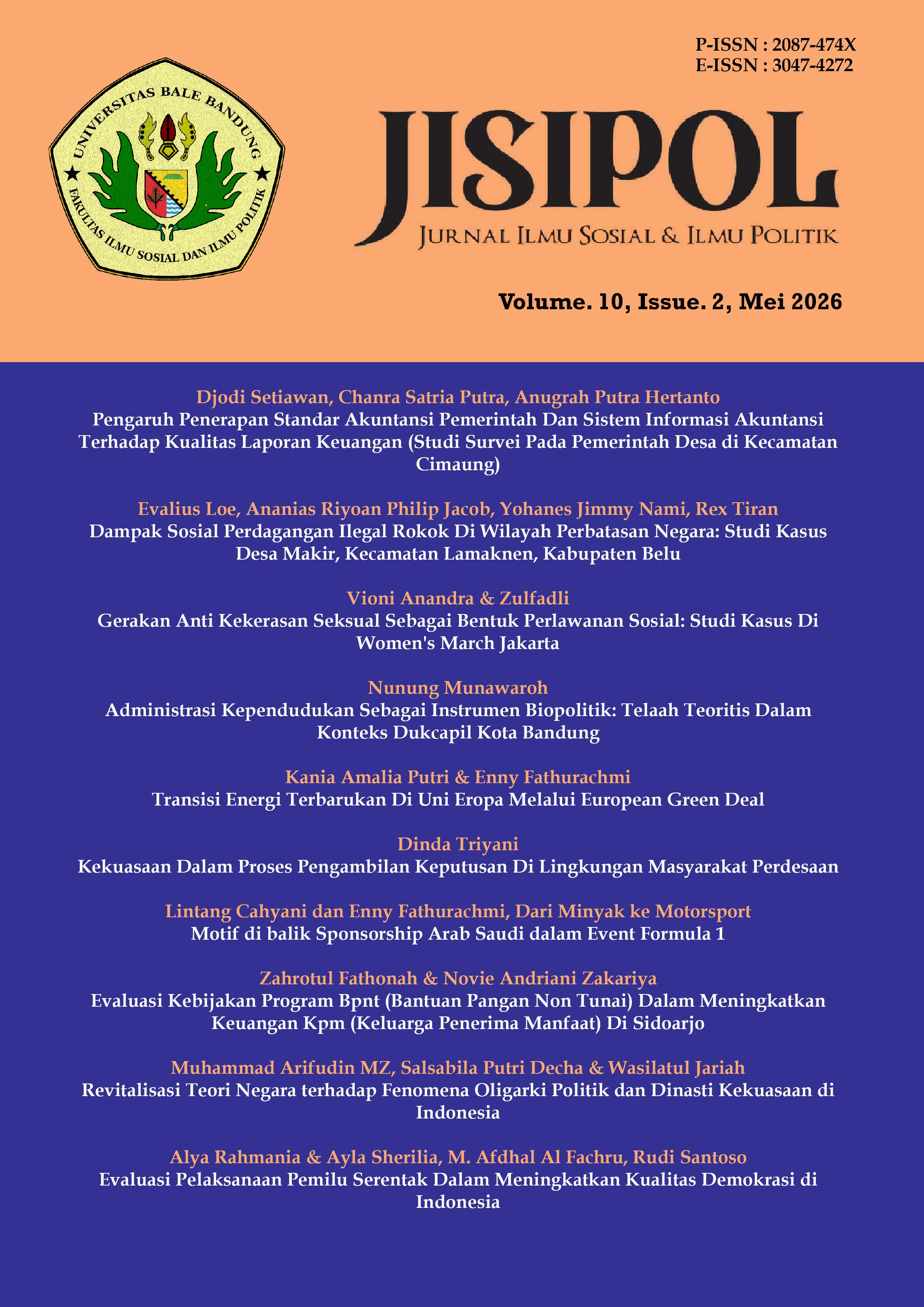
THE ANTI-SEXUAL VIOLENCE MOVEMENT AS A FORM OF SOCIAL RESISTANCE: A CASE STUDY OF THE WOMEN'S MARCH IN JAKARTA
Keywords:
Sexual Violence, Social Movement, Women’s March JakartaAbstract
Sexual violence against women in Indonesia remains a systemic issue, closely linked to patriarchal culture, weak law enforcement, and a lack of safe spaces for survivors, despite the passage of Law No. 12 of 2022 on Sexual Violence Crimes. In this context, Women’s March Jakarta has emerged as a social movement that transforms individual traumatic experiences into collective political demands in the public sphere. This study aims to examine how the anti-sexual violence movement within Women’s March Jakarta functions as a form of social resistance, particularly in building a collective identity among survivors, defining sexual violence as a structural injustice, and demanding the state’s accountability in protecting victims. The research method employed was qualitative, utilizing a case study design focused on the Women’s March Jakarta for the 2022–2023 period, through in-depth interviews with participants and organizers, field observations, and the examination of documents and movement artifacts such as banners, slogans, and social media posts. The research findings indicate that the Women’s March Jakarta created a counter-public that helped survivors break free from the isolation of their personal experiences, leading to an identity as survivor-activists through the repeated practice of storytelling, visual symbols, and actions. This movement also combines urban feminist activism with local cultural elements, opening spaces of solidarity that transcend class, age, and identity, while negotiating dynamics with government authorities and conservative groups. These findings underscore that street actions following the enactment of the TPKS are not merely a form of protest, but rather a hybrid (online and offline) resistance strategy that contributes to shifts in discourse and the management of sexual violence in Indonesia.
Downloads
Published
Issue
Section
License
Copyright (c) 2026 Vioni Anandra, Zulfadli

This work is licensed under a Creative Commons Attribution-ShareAlike 4.0 International License.