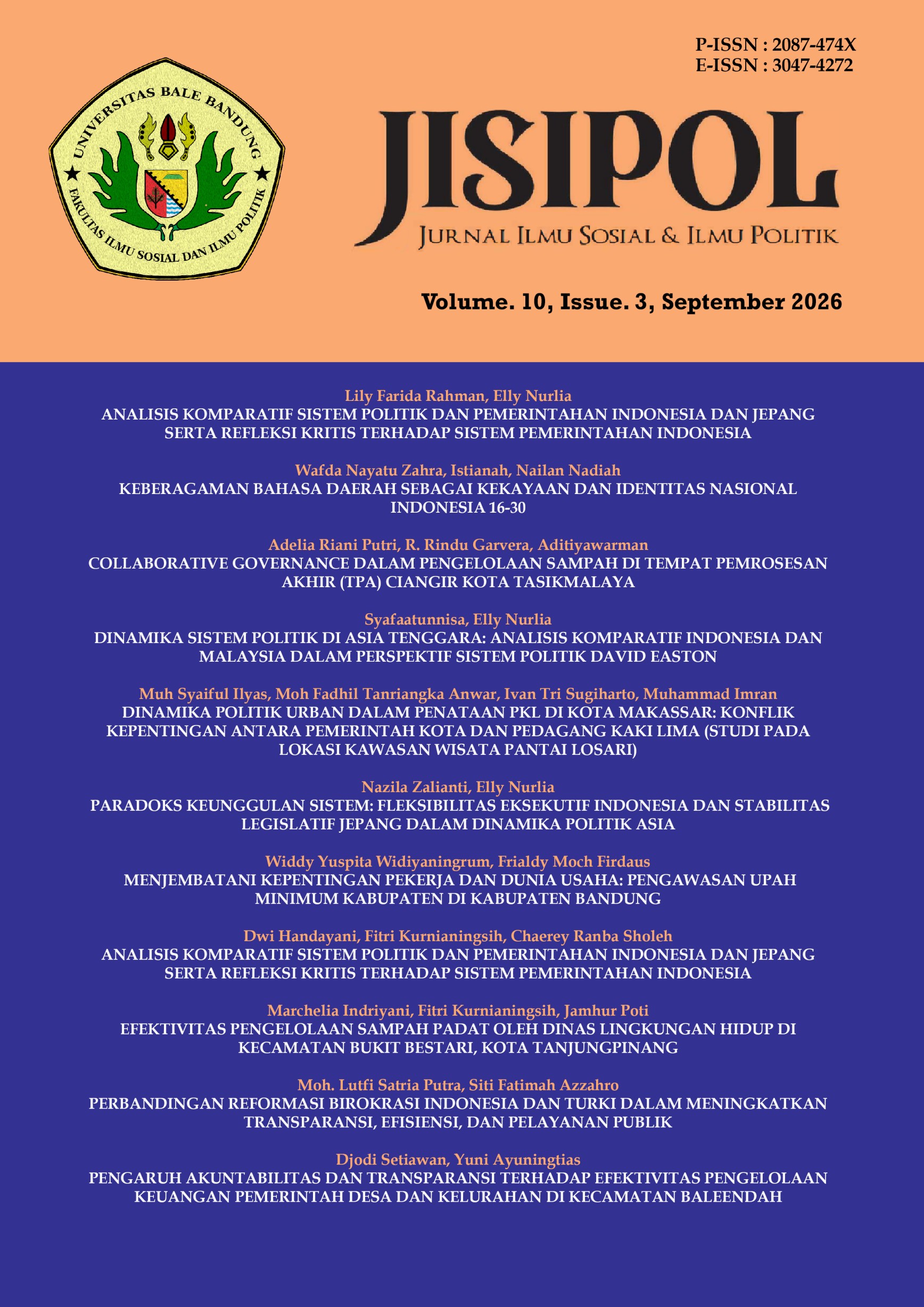
A COMPARATIVE ANALYSIS OF THE POLITICAL AND GOVERNMENTAL SYSTEMS OF INDONESIA AND JAPAN, AND A CRITICAL REFLECTION ON THE INDONESIAN GOVERNMENTAL SYSTEM
Keywords:
Comparative Politics, Political Systems, Indonesia-JepangAbstract
Differences in the stability and effectiveness of political systems across Asia indicate that institutional design alone is insufficient to explain government performance, necessitating a more contextual comparative analysis. This study aims to compare the political and governmental systems of Indonesia and Japan, identify their similarities and differences, analyze the influencing factors across political, economic, cultural, and historical dimensions, and offer a critical reflection on Indonesia. The method used is a literature review with an analytical approach based on David Easton’s political system theory, which encompasses inputs, processes, outputs, and feedback. The results show that Indonesia excels in terms of democratic legitimacy and openness to political participation through direct election mechanisms, yet it still faces challenges regarding policy effectiveness due to the fragmentation of the multiparty system and the dynamics of political compromise. On the other hand, Japan is politically more stable and consistent in its policies, supported by institutional consolidation, party dominance, and a long-term-oriented political culture. These findings highlight the importance of institutional capacity and political culture in improving the quality of governance in Indonesia.
Downloads
Published
Issue
Section
License
Copyright (c) 2026 Lily Farida Rahman, Elly Nurlia

This work is licensed under a Creative Commons Attribution-ShareAlike 4.0 International License.