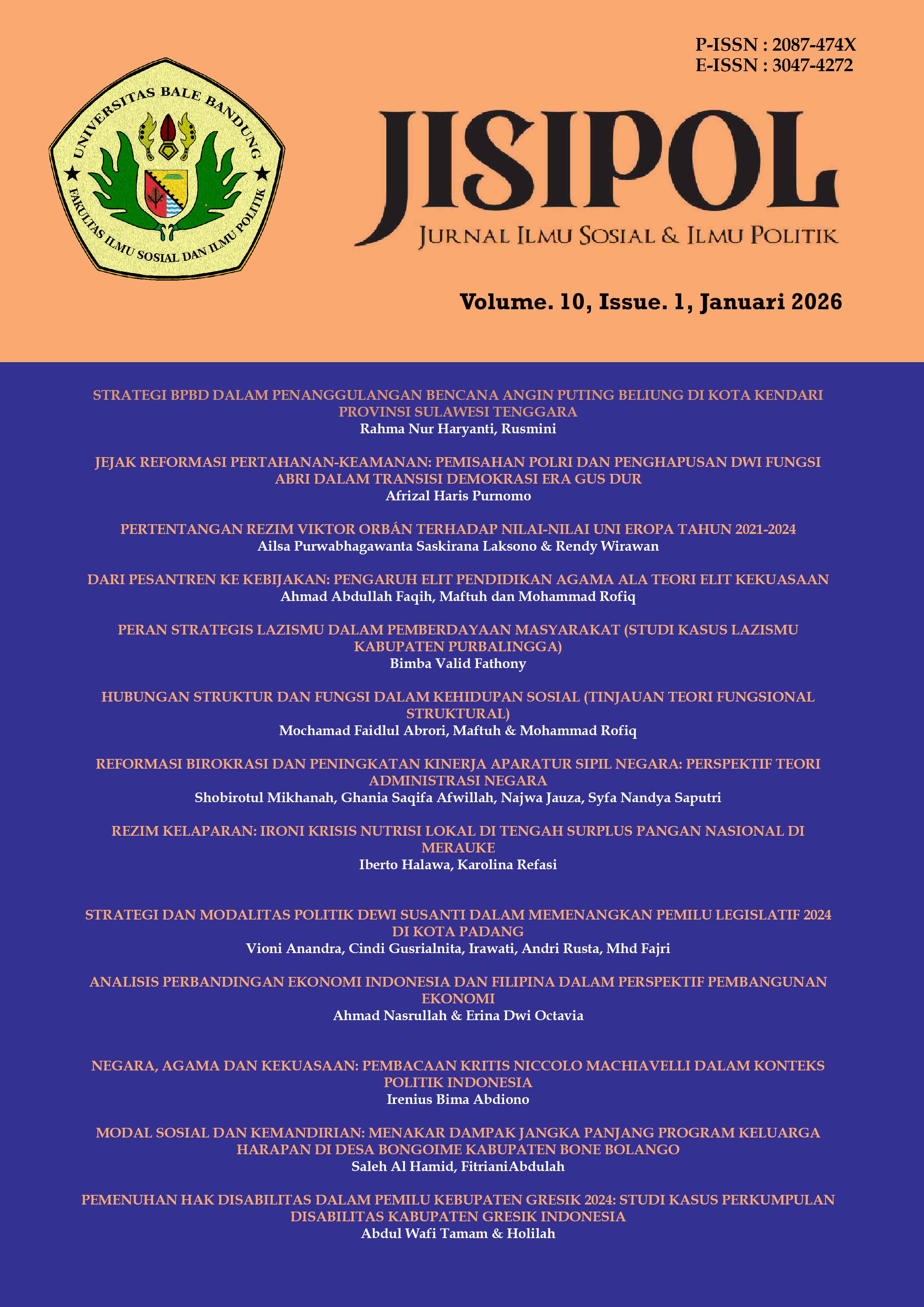
TRACES OF DEFENSE AND SECURITY REFORM: THE SEPARATION OF THE POLICE AND THE ABOLITION OF THE ARMED FORCES’ DUAL FUNCTION IN INDONESIA’S DEMOCRATIC TRANSITION DURING THE GUS DUR ERA
Keywords:
Security Sector Reform, Dwi Fungsi ABRI, TNI–Polri Separation, Abdurrahman Wahid, Civilian SupremacyAbstract
The fall of the New Order regime in 1998 marked the beginning of the Reform Era, bringing major transformations to Indonesia’s political and security systems. One of the main reform agendas was the transformation of the defense and security sector through the separation of the Indonesian National Police (Polri) from the Indonesian National Armed Forces (TNI) and the abolition of the Dwi Fungsi ABRI (dual function) doctrine that had been deeply entrenched for decades. This study aims to analyze the process, policies, challenges, and impacts of security sector reform during the presidency of Abdurrahman Wahid (1999–2001). Using a qualitative approach and library research method combined with historical analysis, the study finds that Wahid’s reform agenda was driven by a strong commitment to civilian supremacy and military professionalism. The separation of Polri from TNI and the abolition of Dwi Fungsi ABRI were crucial steps to strengthen civilian control over the military. Despite structural and cultural obstacles, Gus Dur’s reforms laid a vital foundation for Indonesia’s democratic consolidation and defense–security professionalism.
Downloads
Published
Issue
Section
License
Copyright (c) 2026 afrizal haris

This work is licensed under a Creative Commons Attribution-ShareAlike 4.0 International License.