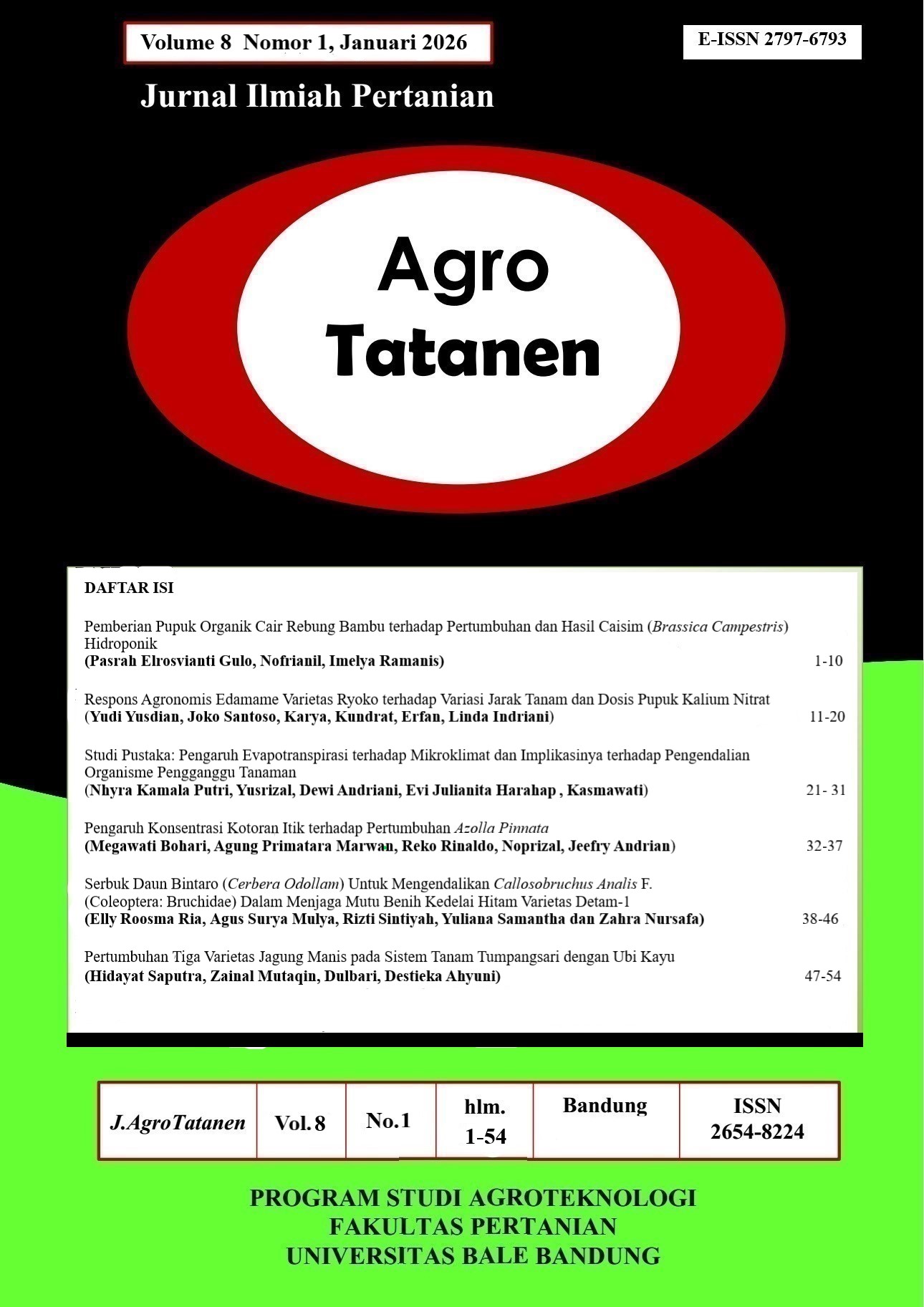
STUDI PUSTAKA: PENGARUH EVAPOTRANSPIRASI TERHADAP MIKROKLIMAT DAN IMPLIKASINYA TERHADAP PENGENDALIAN ORGANISME PENGGANGGU TANAMAN
DOI:
https://doi.org/10.55222/b88vgr96Keywords:
evapotranspiration, microclimate, plant pest organisms, PPO control, sustainable agricultureAbstract
Evapotranspiration (ET), the combined process of evaporation from the soil surface and transpiration from plants, plays a crucial role in forming the microclimate around vegetation. This microclimate significantly influences humidity, temperature, and leaf wetness duration, which are key factors in the dynamics of Plant Pest Organisms (PPOs), such as pests and pathogens. This study aims to examine the relationship between evapotranspiration and the microclimate and its implications for PPO control. The method employed is a literature review, analyzing various relevant journals and scientific sources published within the last ten years. The findings indicate that managing evapotranspiration through techniques such as precision irrigation, selecting appropriate plant varieties, regulating planting distance and timing, controlling shading, ecological engineering and refugia utilization, and employing remote sensing and microclimate sensor technology can suppress excessive humidity that supports PPO development. This approach is not only relevant for PPO control but also supports water use efficiency and climate change adaptation. This review is expected to contribute to the development of ecology- and technology-based sustainable agriculture strategies, particularly in addressing future food production challenges. As a recommendation, integrating ET strategies into Integrated Pest Management (IPM) systems supported by spatial data and artificial intelligence (AI) should be gradually implemented at small scales, with collaborative involvement of researchers, extension agents, and farmers to ensure both technical effectiveness and socioeconomic relevance in tropical agricultural contexts.
References
Aarif K. O., M., Alam, A., & Hotak, Y. (2025). Smart sensor technologies shaping the future of precision agriculture: recent advances and future outlooks. Journal of Sensors, 2025(1), 2460098. https://doi.org/https://doi.org/10.1155/js/2460098.
Abrha, H., & Hagos, H. (2022). Characterization of changing trends of baseline and future predicted precipitation and temperature of Tigray, Ethiopia. Journal of Agrometeorology, 24(3), 235–240.
Acheson, E. S., Galanis, E., Bartlett, K., & Klinkenberg, B. (2019). Climate classification system–based determination of temperate climate detection of Cryptococcus gattii sensu lato. Emerging Infectious Diseases, 25(9), 1723.
Al-Hasani, B., Abdellatif, M., Carnacina, I., Harris, C., Al-Quraishi, A. M. F., & Al-Shammari, M. M. A. (2025). Forecasting evaporation trends amid climate change for sustainable water management in semi-arid regions. Water, 17(7), 1039. https://doi.org/10.3390/w17071039.
Alfizar, & Nasution, S. S. (2024). The explosion of pests and diseases due to climate change. IOP Conference Series: Earth and Environmental Science, 1297(1), 12072.
Ali, M. P., Bari, M. N., Haque, S. S., Kabir, M. M. M., Afrin, S., Nowrin, F., Islam, M. S., & Landis, D. A. (2019). Establishing next-generation pest control services in rice fields: eco-agriculture. Scientific Reports, 9(1), 10180.
Aminatun, T., Suryadarma, I. G. P., Suhartini, S., & Sujangka, A. (2023). Pengaruh variasi jenis dan peletakan refugia terhadap kemelimpahan serangga pada ekosistem sawah. Jurnal Penelitian Saintek, 1(1 SE-Articles), 1–13. https://doi.org/10.21831/jps.v1i1.58324.
Anapalli, S. S., Pinnamaneni, S. R., Reddy, K. N., & Singh, G. (2022). Eddy covariance quantification of corn water use and yield responses to irrigations on farm‐scale fields. Agronomy Journal, 114(4), 2445–2457.
Angon, P. B., Mondal, S., Jahan, I., Datto, M., Antu, U. B., Ayshi, F. J., & Islam, M. S. (2023). Integrated pest management (IPM) in agriculture and its role in maintaining ecological balance and biodiversity. Advances in Agriculture, 2023(1), 5546373.
Attri, K., Gupta, P., Kansal, S., Gupta, M., Goswami, M., & Thakur, S. (2024). Influence of Temperature and Relative Humidity on Spore Germination and Early Blight Disease Development of Tomato Caused by Alternaria solani. International Journal of Economic Plants, 11(August), 290–295.
Bailey, S. L., Morier‐Gxoyiya, C., Puthanvila Surendrababu, S., & Saunders, D. G. O. (2024). A history of strategies and a tapestry of triumphant tales in tackling plant fungal diseases. Plant Pathology, 73(7), 1619–1628.
Bao, Y., Liu, T., Duan, L., Tong, X., Wang, Y., Hao, L., Hua, R., & Singh, V. P. (2025). Partitioning of evapotranspiration in semi-arid rain-fed farmland using an improved stomatal conductance model. Irrigation Science, 43(4), 773–788. https://doi.org/10.1007/s00271-025-01022-z.
Bashyala, S., Poudela, D., & Gautamb, B. (2022). A review on cultural practice as an effective pest management approach under integrated pest management. Trop. Agroecosyst.(TAEC), 3, 34–40.
Bharath, P., Gahir, S., & Raghavendra, A. S. (2021). Abscisic acid-induced stomatal closure: An important component of plant defense against abiotic and biotic stress. Frontiers in Plant Science, 12, 615114.
Bhattarai, G. P., Schmid, R. B., & McCornack, B. P. (2019). Remote sensing data to detect Hessian fly infestation in commercial wheat fields. Scientific Reports, 9(1), 6109.
Buckley, L. B., Arakaki, A. J., Cannistra, A. F., Kharouba, H. M., & Kingsolver, J. G. (2017). Insect development, thermal plasticity and fitness implications in changing, seasonal environments. Integrative and Comparative Biology, 57(5), 988–998.
Choudhary, R., Mantri, S. P., Barse, M. V. A., & Chitnis, S. (2024). Leveraging AI in smart agro-informatics: a review of data science applications. International Research Journal on Advanced Engineering and Management (IRJAEM), 2(06), 1964–1975.
Comfort, I., Chinweaku, A. C., Chidinma, J., Nwaizuzu, D., & Paul, E. T. (2025). Advancements in IoT - Based Data Logging for Crop Evapotranspiration Monitoring : Trends and Challenges : A Review. IJLTEMAS, XIV(III), 354–360. https://doi.org/10.51583/IJLTEMAS.
Dawid, I., Workalemahu, S., & Hassen, A. (2021). Small scale irrigation farming adoption as a climate-smart agriculture practice and its impact on household income in Ethiopia: A Review. International Journal of Food Science and Agriculture, 5(4).
Fahad, S., Chavan, S. B., Chichaghare, A. R., Uthappa, A. R., Kumar, M., Kakade, V., Pradhan, A., Jinger, D., Rawale, G., & Yadav, D. K. (2022). Agroforestry systems for soil health improvement and maintenance. Sustainability, 14(22), 14877.
Fausan, A., Setiawan, B. I., Arif, C., & Saptomo, S. K. (n.d.). Analisa model evaporasi dan evapotranspirasi menggunakan pemodelan matematika pada visual Basic di Kabupaten Maros. Jurnal Teknik Sipil dan Lingkungan, 5(3 SE-Research Articles), 179–196. https://doi.org/10.29244/jsil.5.3.179-196.
Ganesh, G. C., & Roka, P. (2024). Sheath blight of rice: a review of host plant interaction and disease management. Archives of Agriculture and Environmental Science, 9(2), 404–408.
Garg, D., Singh, H., & Shacham-Diamand, Y. (2025). AdapTree: data-driven approach to assessing plant stress through the AI-sensor synergy. Sensors, 25(10), 3149.
Gerhards, M., Schlerf, M., Rascher, U., Udelhoven, T., Juszczak, R., Alberti, G., Miglietta, F., & Inoue, Y. (2018). Analysis of airborne optical and thermal imagery for detection of water stress symptoms. Remote Sensing, 10(7), 1139.
Gobbo, S., Lo Presti, S., Martello, M., Panunzi, L., Berti, A., & Morari, F. (2019). Integrating SEBAL with in-field crop water status measurement for precision irrigation applications—A case study. Remote Sensing, 11(17), 2069.
Goncalves, I. Z., Neale, C. M. U., Akasheh, S., & Barker, B. (2023). Remote sensing-based evapotranspiration modeling for several land uses using SETMI model for Nebraska. Remote Sensing for Agriculture, Ecosystems, and Hydrology XXV, 12727, 267–271.
Gupta, H. P., Song, H., Sikdar, B., Dutta, T., & Faigl, J. (2021). Guest Editorial Special Issue on Smart Sensing for Agriculture. IEEE Sensors Journal, 21(16), 17419.
Hariyadi, N. N., Rosa, H. O., & Sepe, M. (2025). Rice brown planthopper incidence and diversity of natural enemies in Indonesia. Indian Journal of Entomology, 87(1).
Hasyim, A., Setiawati, W., & Lukman, L. (2015). Inovasi teknologi pengendalian OPT ramah lingkungan pada cabai: upaya alternatif menuju ekosistem harmonis. Pengembangan Inovasi Pertanian, 8(1). https://doi.org/10.21082/pip.v8n1.2015.1-10.
Hatfield, J. L., & Dold, C. (2019). Water-use efficiency: advances and challenges in a changing climate. Frontiers in Plant Science, 10, 103.
Hogan, P., Parajka, J., Oismüller, M., Heng, L., Strauss, P., & Blöschl, G. (2020). High-frequency stable-isotope measurements of evapotranspiration partitioning in a maize field. Water, 12(11), 3048.
Hossain, M. M., Sultana, F., Mostafa, M., Ferdus, H., Rahman, M., Rana, J. A., Islam, S. S., Adhikary, S., Sannal, A., Al Emran Hosen, M., Nayeema, J., Emu, N. J., Kundu, M., Biswas, S. K., Farzana, L., & Al Sabbir, M. A. (2024). Plant disease dynamics in a changing climate: impacts, molecular mechanisms, and climate-informed strategies for sustainable management. In Discover Agriculture (Vol. 2, Issue 1). Springer International Publishing. https://doi.org/10.1007/s44279-024-00144-w.
Jasrotia, P., Kumari, P., & Kashyap, P. L. (2025). Next-Gen Strategies in Host Plant Resistance to Insects: Breakthroughs and Future Horizons BT - Cutting Edge Technologies for Developing Future Crop Plants (A. Mann, N. Kumar, A. Kumar, P. Chandra, S. K. Sanwal, & P. Sheoran (eds.); pp. 219–247). Springer Nature Singapore. https://doi.org/10.1007/978-981-96-2508-6_11.
Jayadharshan, S., Marimuthu, S., Gurusamy, A., Kannan, P., Sivamurugan, A. P., Pazhanivelan, S., & Sudarmanian, N. S. (2025). Advancing pulse crop resilience: Leveraging DSSAT for climate-smart agriculture: A comprehensive review. Plant Science Today. https://doi.org/10.14719/pst.8016.
Jeavons, E., Van Baaren, J., Le Ralec, A., Buchard, C., Duval, F., Llopis, S., Postic, E., & Le Lann, C. (2022). Third and fourth trophic level composition shift in an aphid–parasitoid–hyperparasitoid food web limits aphid control in an intercropping system. Journal of Applied Ecology, 59(1), 300–313.
Jiang, Y., Tang, R., Jiang, X., Li, Z., & Gao, C. (2019). Estimation of soil evaporation and vegetation transpiration using two trapezoidal models from MODIS data. Journal of Geophysical Research: Atmospheres, 124(14), 7647–7664.
Kadao, A. K., & Shivaji, G. B. (2025). Smart Farming: AI and IoT-Based Solutions for Real-Time Agriculture Monitoring. SHS Web of Conferences, 216, 1040.
Kaya, C. (2025). Optimizing crop production with plant phenomics through high‐throughput phenotyping and AI in controlled environments. Food and Energy Security, 14(1), e70050.
Keskes, M. (2025). Review of The Current State of Deep Learning Applications in Agriculture.
Khoi, T. A. (2025). Impacts of climate change on agricultural production in Lam Dong, Vietnam. Journal of Climate Policy, 4(1), 37–52.
Kim, T. H., & AlZubi, A. A. (2024). AI-enhanced precision irrigation in legume farming: optimizing water use efficiency. Legume Research, 47(8), 1382–1389.
Kumar, R., & Kaur, P. (2024). Handbook of Integrated Weed Management for Major Field Crops. Bentham Science Publishers.
Lakhiar, I. A., Yan, H., Zhang, C., Zhang, J., Wang, G., Deng, S., Syed, T. N., Wang, B., & Zhou, R. (2024). A review of evapotranspiration estimation methods for climate-smart agriculture tools under a changing climate: vulnerabilities, consequences, and implications. Journal of Water and Climate Change, 16(2), 249–288. https://doi.org/10.2166/wcc.2024.048
Leiwakabessy, C., Inayatri, F., Jambormias, E., Patty, J., & Ririhena, R. E. (2020). Ketahanan enam varietas Padi terhadap penyakit blas (Pyricularia oryzae Cav.) pada lahan sawah irigasi dan sawah tadah hujan. Jurnal Budidaya Pertanian, 16(2), 147–156.
Li, W., Wainwright, H. M., Yan, Q., Zhou, H., Dafflon, B., Wu, Y., Versteeg, R., & Tartakovsky, D. M. (2021). Estimation of evapotranspiration rates and root water uptake profiles from soil moisture sensor array data. Water Resources Research, 57(11), e2021WR030747.
Li, Y., Huang, X., & Huang, Z. (2020). Behavioral adjustments and support use of François’ langur in limestone habitat in Fusui, China: Implications for behavioral thermoregulation. Ecology and Evolution, 10(11), 4956–4967.
Liu, B., Hou, J., Ge, H., Liu, M., Shi, L., Li, C., & Cui, Y. (2023). Comparison of evapotranspiration partitioning and dual crop coefficients of direct-Seeded and transplanted rice in the Poyang Lake basin, China. Agronomy, 13(5), 1218.
Liu, B., Zhao, J., Hou, Y., Jia, H., Huang, Z., Hu, X., Wu, J., & Ying, Y. (2025). Effects of different irrigation water sources on farmland soil microbial communities under drought stress. World Journal of Microbiology and Biotechnology, 41(10), 405.
M’hamdi, O., Égei, M., Pék, Z., Ilahy, R., Nemeskéri, E., Helyes, L., & Takács, S. (2023). Root development monitoring under different water supply levels in processing tomato plants. Plants, 12(20), 3517.
Manokaran, J. (2025). AI-Powered IoT-Based Smart Agriculture for Sustainable Crop Management. International Journal Of Scientific Research In Engineering And Management, 09, 1–9. https://doi.org/10.55041/IJSREM41447.
Mansoor, S., Iqbal, S., Popescu, S. M., Kim, S. L., Chung, Y. S., & Baek, J.-H. (2025). Integration of smart sensors and IOT in precision agriculture: trends, challenges and future perspectives. Frontiers in Plant Science, 16, 1587869.
Mariantika, L., Retnaningdyah, C., & Arisoesilaningsih, E. (2019). Agroecosystem degradation evaluation of broccoli (Brassica oleracea) farm using some biotic indices in Batu, East Java, Indonesia. Jurnal Pembangunan Dan Alam Lestari, 10(1).
McLaughlin, B. C., Ackerly, D. D., Klos, P. Z., Natali, J., Dawson, T. E., & Thompson, S. E. (2017). Hydrologic refugia, plants, and climate change. Global Change Biology, 23(8), 2941–2961.
Meza, K., Torres‐Rua, A. F., Hipps, L., Kopp, K., Straw, C. M., Kustas, W. P., Christiansen, L., Coopmans, C., & Gowing, I. (2025). Relating spatial turfgrass quality to actual evapotranspiration for precision golf course irrigation. Crop Science, 65(1), e21446.
Mishra, S., & Mishra, R. C. (2023). Review of the Impact of Drip Irrigation Mulching on Soil Characteristics and Efficiency in Water Usage. International Journal of Environment and Climate Change, 13(10), 4373–4383. https://doi.org/10.9734/ijecc/2023/v13i103114.
Molaei, B., Peters, R. T., Chandel, A. K., Khot, L. R., Stockle, C. O., & Campbell, C. S. (2023). Measuring evapotranspiration suppression from the wind drift and spray water losses for LESA and MESA sprinklers in a center pivot irrigation system. Water, 15(13), 2444.
Mosedale, J. R., Eyre, D., Korycinska, A., Everatt, M., Grant, S., Trew, B., Kaye, N., Hemming, D., & Maclean, I. M. D. (2024). Mechanistic microclimate models and plant pest risk modelling. Journal of Pest Science, 97(4), 1749–1766. https://doi.org/10.1007/s10340-024-01777-y.
Moustakas, M. (2025). Molecular Mechanisms of Plant Abiotic Stress Tolerance. International Journal of Molecular Sciences, 26(6), 2731. https://doi.org/10.3390/ijms26062731.
Nawaz, R., Abbasi, N. A., Hafiz, I. A., Khan, M. F., & Khalid, A. (2021). Environmental variables influence the developmental stages of the citrus leafminer, infestation level, and mined leaves' physiological response of Kinnow mandarin. Scientific Reports, 11(1), 7720.
Nemeskéri, E., Neményi, A., Bőcs, A., Pék, Z., & Helyes, L. (2019). Physiological factors and their relationship with the productivity of processing tomato under different water supplies. Water, 11(3), 586.
Novitaningrum, R., Supardi, S., & Marwanti, S. (2019). Efisiensi teknis pengelolaan tanaman terpadu padi sawah di Kabupaten Karanganyar, Provinsi Jawa Tengah. Jurnal Agro Ekonomi, 37(2), 123–140.
Oh, S. K., & Cho, Y. S. (2025). Effects of water management practices on rice grain quality and pest-disease incidence in environmentally friendly cultivation systems. Agriculture, 15(21), 2244.
Pan, S., Liu, L., Bai, Z., & Xu, Y.-P. (2018). Integration of remote sensing evapotranspiration into multi-objective calibration of distributed hydrology–soil–vegetation model (DHSVM) in a humid region of China. Water, 10(12), 1841.
Patange, M. J., Abhishek, G. J., Ashwini, T. R., Lakra, T. S., Verma, L. P., Dutt, A., Singh, M. P., Kushwaha, K., & Chanyal, P. C. (2024). Applications of hyperspectral remote sensing, GIS, and artificial intelligence in agriculture. Archives of Current Research International, 24(7), 1–13.
Rabie, A. B., Elhag, M., & Subyani, A. (2025). Remote sensing, GIS, and machine learning in water resources management for arid agricultural regions: a review. Water, 17(21), 3125.
Rahayu, S., Triyogo, A., Widyastuti, S. M., Musyafa’, & Ardianyah, F. (2021). Pests and diseases on Falcataria moluccana trees in agroforestry systems with pineapple in East Java, Indonesia. Biodiversitas, 22(5), 2779–2788. https://doi.org/10.13057/biodiv/d220541.
Ramos, R. F., Franco, A. M. A., Gilroy, J. J., & Silva, J. P. (2023). Combining bird tracking data with high-resolution thermal mapping to identify microclimate refugia. Scientific Reports, 13(1), 4726. https://doi.org/10.1038/s41598-023-31746-x.
Ranwa, M., Sri, K. R., Khare, A., Kumar, V., Kumar, K., Rajeshwar, J. R., & Niharika, N. (2024). A summative review of advances in sensor technology for precision agriculture. Archives of Current Research International, 24(10 SE-Review Article), 257–275. https://doi.org/10.9734/acri/2024/v24i10929.
Raza, A., Hu, Y., Acharki, S., Buttar, N. A., Ray, R. L., Khaliq, A., Zubair, N., Zubair, M., Syed, N. R., & Elbeltagi, A. (2023).
Evapotranspiration Importance in Water Resources Management Through Cutting-Edge Approaches of Remote Sensing and Machine Learning Algorithms BT - Surface and Groundwater Resources Development and Management in Semi-arid Region: Strategies and Solutions (C. B. Pande, M. Kumar, & N. L. Kushwaha (eds.); pp. 1–20). Springer International Publishing. https://doi.org/10.1007/978-3-031-29394-8_1.
Riddick, E. W. (2022). Topical Collection : Natural Enemies and Biological Control of Plant Pests. Insects, 421(13), 13–15.
Roby, T. J., & Kallarackal, J. (2017). Estimation of evapotranspiration in a tropical wildlife sanctuary using GIS and remote sensing techniques. Forest Res Eng Int J, 1(3), 13.
Rosa-Diaz, I., Rowe, J., Cayuela-López, A., Arbona, V., Díaz, I., & Jones, A. M. (2024). Spider mite herbivory induces an ABA-driven stomatal defense. Plant Physiology, 195(4), 2970–2984. https://doi.org/10.1093/plphys/kiae215.
Rowlandson, T., Gleason, M., Sentelhas, P., Gillespie, T., Thomas, C., & Hornbuckle, B. (2015). Reconsidering Leaf Wetness Duration Determination for Plant Disease Management. Plant Disease, 99(3), 310–319. https://doi.org/10.1094/PDIS-05-14-0529-FE.
Roy, S., Hoque, A., Saikia, P., & Padhiary, M. (2025). Climate-Smart Agriculture: AI-Based Solutions for Enhancing Crop Resilience and Reducing Environmental Impact. Asian Research Journal of Agriculture, 18(1), 291–310. https://doi.org/10.9734/arja/2025/v18i1665.
Sabir, R. M., Jawad, S., Ali, F., Mahmood, M. H., Tanveer, H., Shoaib, M., Quddos, Z., Arif, M., Azam, S., Nawaz, N., & Muhammad, N. (2025). AI in Sustainable Farming: Revolutionizing Precision Agriculture. In G. J & M. R (Eds.), AI and Ecological Change for Sustainable Development (pp. 441–472). IGI Global Scientific Publishing. https://doi.org/10.4018/979-8-3373-0680-3.ch015.
Santri, I. P., Adawiyah, R., & Ramadhani, P. (2025). Pengaruh Perlakuan pada Daun dan Batang Terhadap Laju Evapotranspirasi pada Tanaman Waru (Hibiscus tiliaceus) dan Pinus (Pinus merkusii). Mesada: Journal of Innovative Research, 1(2 SE-Articles), 231–238. https://doi.org/10.61253/vvaf7n59.
Senior, R. A., Hill, J. K., Benedick, S., & Edwards, D. P. (2018). Tropical forests are thermally buffered despite intensive selective logging. Global Change Biology, 24(3), 1267–1278. https://doi.org/10.1111/gcb.13914.
Sharma, S. (2023). Cultivating Sustainable Solutions: Integrated Pest Management (IPM) for Safer and Greener Agronomy. Corporate Sustainable Management Journal, 1(2), 103–108. https://doi.org/10.26480/csmj.02.2023.103.108.
Shruthi, M. R., & Anil, K. K. N. (2025). AI-Driven Techniques for Real-Time Crop Monitoring in Smart Agriculture. International Journal Of Scientific Research In Engineering And Management, 09(08), 1–9. https://doi.org/10.55041/IJSREM51797.
Sikka, A. K., Islam, A., & Rao, K. V. (2018). Climate-Smart Land and Water Management for Sustainable Agriculture. Irrigation and Drainage, 67(1), 72–81. https://doi.org/10.1002/ird.2162.
Singh, S., Reddy, K. S., Bhowmick, M. K., Srivastava, A. K., Kumar, S., & Peramaiyan, P. (2025). Accelerating Climate Adaptation with Big Data Analytics and ICTs BT - Advances in Agri-Food Systems: Volume I (H. Pathak, W. S. Lakra, A. Gopalakrishnan, & K. C. Bansal (eds.); pp. 179–196). Springer Nature Singapore. https://doi.org/10.1007/978-981-96-0759-4_10.
Small, E. E., Badger, A. M., Abolafia-Rosenzweig, R., & Livneh, B. (2018). Estimating Soil Evaporation Using Drying Rates Determined from Satellite-Based Soil Moisture Records. In Remote Sensing (Vol. 10, Issue 12, p. 1945). https://doi.org/10.3390/rs10121945.
Ulina, E. S., & Hasibuan, M. (2024). Manipulating the community structure of arthropods in rice fields with floral resource plants. IOP Conference Series: Earth and Environmental Science, 1377(1), 12107. https://doi.org/10.1088/1755-1315/1377/1/012107.
Vala, Y., Sekhar, M., Sudeepthi, B., Thriveni, V., Lallawmkimi, M. C., Ranjith, R., & Reddy, S. E. (2024). A Review on the Influence of Climate Change on Agronomic Practices and Crop Adaptation Strategies. Journal of Experimental Agriculture International, 46(10 SE-Review Article), 671–686. https://doi.org/10.9734/jeai/2024/v46i102991.
Wang, S., Zhang, Q., Yue, P., & Wang, J. (2020). Effects of evapotranspiration and precipitation on dryness/wetness changes in China. Theoretical and Applied Climatology, 142(3), 1027–1038. https://doi.org/10.1007/s00704-020-03336-8.
Wei, Z., Yoshimura, K., Wang, L., Miralles, D. G., Jasechko, S., & Lee, X. (2017). Revisiting the contribution of transpiration to global terrestrial evapotranspiration. Geophysical Research Letters, 44(6), 2792–2801. https://doi.org/https://doi.org/10.1002/2016GL072235.
Wilkin, K. M., Ackerly, D. D., & Stephens, S. L. (2016). Climate Change Refugia, Fire Ecology and Management. Forests, 7(4), 77. https://doi.org/10.3390/f7040077.
Xing, W., Wang, W., Shao, Q., Song, L., & Cao, M. (2021). Estimation of Evapotranspiration and Its Components across China Based on a Modified Priestley–Taylor Algorithm Using Monthly Multi-Layer Soil Moisture Data. Remote Sensing, 13(16), 3118. https://doi.org/10.3390/rs13163118.
Xu, H., Chen, H., Qian, C., & Li, J. (2024). The Evapotranspiration Characteristics and Evaporative Cooling Effects of Different Vegetation Types on an Intensive Green Roof : Dynamic Performance Under Different Weather Conditions. Sustainability, 16(10812).
Yang, Z., Jiang, Y., Qiu, R., Gong, X., Agathokleous, E., Hu, W., & Clothier, B. (2023). Heat stress decreased transpiration but increased evapotranspiration in gerbera. Frontiers in Plant Science, 14(January), 1–13. https://doi.org/10.3389/fpls.2023.1119076.
Yasuda, S., Shinozawa, A., Hirase, T., Weng, Y., Ishizak, H., Suzuki, R., Ueda, S., Sk, R., Yotsui, I., Toyota, M., Okamoto, M., Saijo, Y., Okamoto, M., Rajendram, A., Hirase, T., Ishizaki, H., Suzuki, R., Ueda, S., Sk, R., … Saijo, Y. (2025). Humidity-driven ABA depletion determines plant-pathogen competition for leaf water. BioRxiv, 1–37. https://doi.org/10.1101/2025.01.04.631318.
Yusuf, A. G., Al-Yahya, F. A., Saleh, A. A., & Abdel-Ghany, A. M. (2025). Optimizing greenhouse microclimate for plant pathology: challenges and cooling solutions for pathogen control in arid regions. Frontiers in Plant Science, 16(February), 1–15. https://doi.org/10.3389/fpls.2025.1492760.
Zhang, D., Zhou, X., Zhang, J., Lan, Y., Xu, C., & Liang, D. (2018). Detection of rice sheath blight using an unmanned aerial system with high-resolution color and multispectral imaging. PLOS ONE, 13(5), e0187470. https://doi.org/10.1371/journal.pone.0187470.
Zhang, H., Zhao, T., Ji, R., Chang, S., Gao, Q., & Zhang, G. (2023). The Decreased Availability of Soil Moisture and Canopy Conductance Dominate Evapotranspiration in a Rain-Fed Maize Ecosystem in Northeastern China. Agronomy, 13(12), 2941. https://doi.org/10.3390/agronomy13122941.
Zhang, K., Kimball, J. S., & Running, S. W. (2016). A review of remote sensing-based actual evapotranspiration estimation. Wiley Interdisciplinary Reviews: Water, 3, 834–853. https://doi.org/10.1002/wat2.1168.
Zhao, T. (2023). Advances in plant immunity and disease resistance breeding. Second International Conference on Biological Engineering and Medical Science (ICBioMed 2022), 12611, 62. https://doi.org/10.1117/12.2669038.
Zhou, L., Zhang, L., Liu, Q., Chen, Y., He, Z., Li, S., & Ma, X. (2025). Effects of Canopy Litter Removal on Canopy Structure , Understory Light and Vegetation Dynamics in Cunninghamia lanceolata Plantations of Varying Densities. Plants, 14(3144), 1–19.
Zhuang, Q., Wang, H., & Xu, Y. (2020). Comparison of Remote Sensing-based Multi-Source ET Models over Cropland in a Semi-Humid Region of China. Atmosphere, 11(4), 325. https://doi.org/10.3390/atmos11040325.
Zidan, F., & Febriyanti, D. E. (2024). Optimizing Agricultural Yields with Artificial Intelligence-Based Climate Adaptation Strategies. IAIC Transactions on Sustainable Digital Innovation (ITSDI), 5(2), 136–147.
Downloads
Published
Data Availability Statement
The data generated and/or analyzed during this study are available from the corresponding author upon reasonable request.