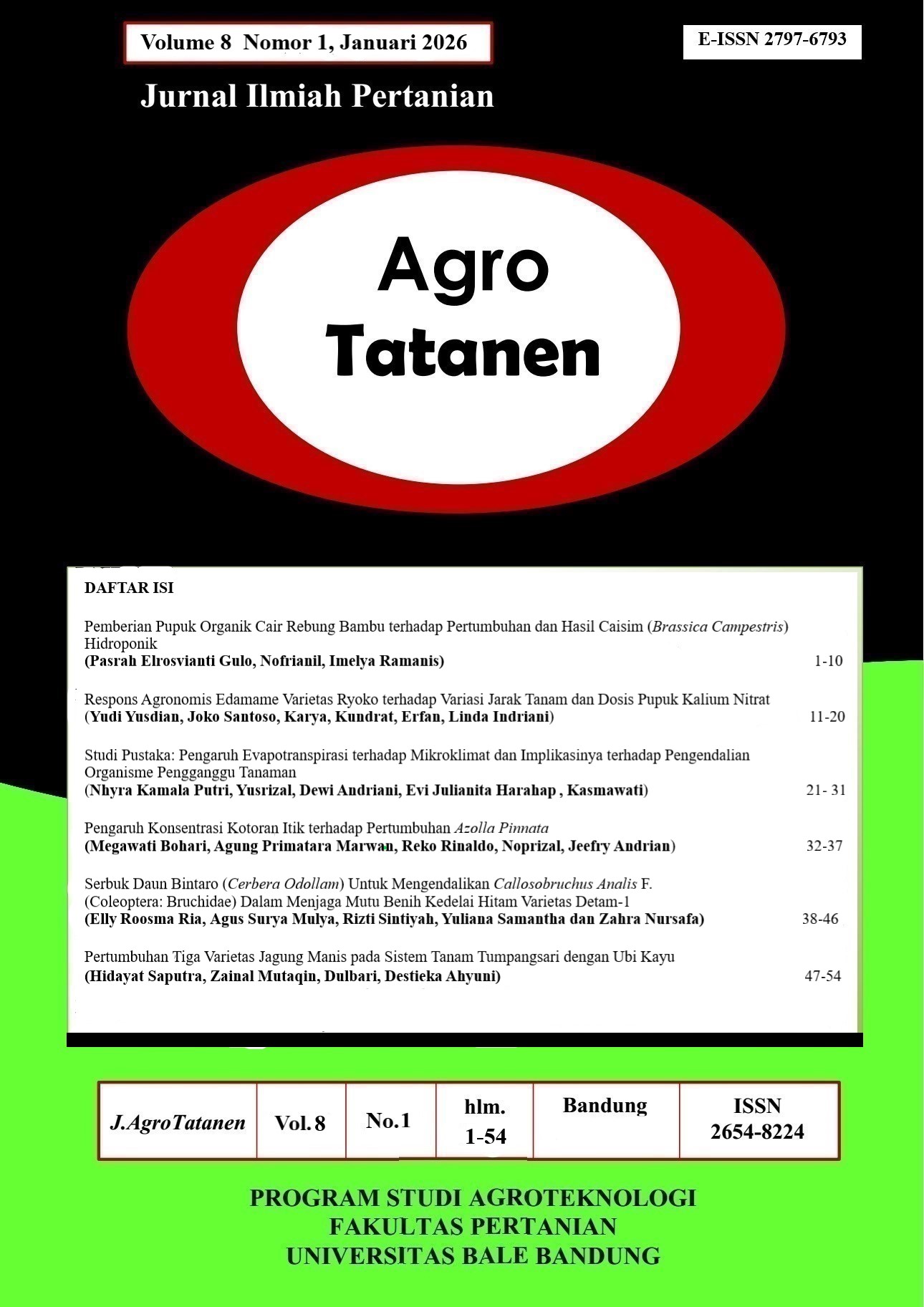
PERTUMBUHAN TIGA VARIETAS JAGUNG MANIS PADA SISTEM TANAM TUMPANGSARI DENGAN UBI KAYU
DOI:
https://doi.org/10.55222/0r6fse65Keywords:
Leaf length, leaf width, intercropping, planting positionAbstract
Cassava farmers will earn income from their farming business after harvesting 7-10 months later. With a fairly wide spacing of cassava plants (1-2 m), there is potential growing space under the cassava stands that can be intercropped with annual crops. In order for the intercrops planted with cassava to grow and produce optimally, it is necessary to arrange the layout of the sweet corn planting. In addition, information is also needed regarding sweet corn varieties that are suitable and adaptive for intercropping with cassava. This study aims to study the best sweet corn planting pattern that can produce growth and yield of sweet corn in an intercropping system, and to determine the best sweet corn varieties in the intercropping pattern of sweet corn with cassava. There are six combinations of planting treatments and sweet corn varieties. These treatments include: two layouts or planting positions of sweet corn, namely between cassava rows (J1) and within cassava rows (J2), and three commercial sweet corn varieties: Mira (V1), Paragon (V2), and Bonanza (V3). The results showed that sweet corn planted under cassava stands experienced a decrease in vegetative growth of 144 to 400% compared to sweet corn in a monoculture system, sweet corn planted between rows of cassava plants had better growth than those planted between rows of cassava, and sweet corn of the Bonanza variety was able to adapt better when intercropped with cassava.
References
Adiele, J. G., Schut, A. G. T., B, van den, Ezui, R. P. M., Pypers, K. S., & Ano, P. (2020). Towards closing cassava yield gap in West Africa: agronomic efficiency and storage root yield responses to NPK fertilizers. Field Crops Res, 253, 107820. https://doi.org/10.1016/j.fcr.2020.107820.
Aisyah, Y., & Herlina, N. (2018). Pengaruh Jarak Tanam Jagung Manis pada Tumpangsari Tiga Varietas Tanaman Kedelai. Jurnal Produksi Tanaman, 6, No.1.
Badan Pusat Statistik (BPS). (2015). [2 Maret 2022]. Indikator Pertanian Agricultural Indicator 2014/2015. https://www.bps.go.id/website/pdf_publikasi/Indikator-pertanian-2014-2015.rev.pdf.
Delaquis, E., S, de H., & Wyckhuys, K. A. G. (2018). On-farm diversity offsets environmental pressures in tropical agroecosystems: a synthetic review for cassava-based systems. Agric. https://doi.org/10.1016.
Enesi, R. O., Pypers, P., Kreye, C., Tariku, M., Six, J., & Hauser, S. (2022). Effects of expanding cassava planting and harvesting windows on root yield, starch content, and revenue in southwestern Nigeria. Field Crop Res, 286, 108639. https://doi.org/10.1016/j.
Fan, Y., Chen, J., Cheng, Y., Raza, M. A., Wu, X., & Wang, Z. (2018). Effect of shading and light recovery on soybean growth, leaf structure, and photosynthetic performance in a maize soybean relay-strip intercropping system. PLoS ONE, 13(5), e0198159. https://doi.org/10.1371.
Giftson, S. J., Singh, R., & Indu, T. (2024). Effect of row orientation and spacing on growth and yield of sweet corn. International Journal of Research in Agronomy, 7(4), 747–749. https://doi.org/10.33545/2618060x.2024.v7.i4j.634.
He, C., Zhou, B., Wang, H., Wei, Y., & Huang, J. (2023). A first-year maize/cassava relay intercropping system improves soil nutrients and changes the soil microbial community in the symbiotic period. Frontier Microbiology, 14, 1087202. https://doi.org/10.3389/fmicb.2023.1087202.
Huang, C., Quan-qing, L., Xiao-lin, L., & Chao-chun, L. (2019). Effect of intercropping on maize grain yield and yield components. Journal of Integrative Agriculture, 18(8), 1690–1700.
Iqbal, A., He, L., Khan, A., Wei, S., Akhtar, K., Ali, I., Ullah, S., Munsif, F., Zhao, Q., & Jiang, L. (2019). Organic Manure Coupled with Inorganic Fertilizer: An Approach for the Sustainable Production of Rice by Improving Soil Properties and Nitrogen Use Efficiency. Agronomy, 9(10), 651. https://doi.org/10.3390/agronomy9100651.
Khongdee, N., Tongkoom, K., Iamsaard, K., Mawan, N., Yimyam, N., Sanjunthong, W., Khongdee, P., & Wicharuck, S. (2022). Closing the yield gap of maize in Southeast Asia by intercropping systems: A review. Australian Journal of Crop Science, 16(11), 1224–1233.
Kristiono, A., Siti, M., Dian, A. A. E., & Arief, H. (2020). Produktivitas Tumpangsari Kedelai dengan Jagung pada Akhir Musim Hujan di Lahan Kering Beriklim Kering. Jurnal Pangan, 29(3), 197-210.
Lewa, K., Chivatsi, W., Saha, H., & Muinga, R. (2019). Maize–Cassava Intercropping: An Effort to Increase Food and Feed Security and Incomes in Coastal Lowland Kenya. East African Agricultural and Forestry Journal, 83(4), 341–350. https://doi.org/10.1080/00128325.2019.1659214.
Liang, Q., Chang, H., Chen, H., Wu, Q., Qin, Y., Wang, Z., Wang, G., Li, X., Chen, W., Wu, J., Wang, Q., & Wang, J. (2025). The agronomic mechanism of root lodging resistance and yield stability for sweet corn in response to planting density and nitrogen rates at different planting dates. Frontiers in Plant Science, 16. https://doi.org/10.3389/fpls.2025.1481033.
Madembo, c, Blessing, M., & Thierfelder, C. (2020). Productivity or stability? Exploring maize-legume intercropping strategies for smallholder Conservation Agriculture farmers in Zimbabwe. Agricultural Systems. https://doi.org/10.1016/j.agsy.2020.102921.
Mahakosee, S., Jogloy, S., Vorasoot, N., Theerakulpisut, P., Toomsan, B., Holbrook, C. C., Kvien, C. K., & Banterng, P. (2022). Light Interception and Radiation Use Efficiency of Three Cassava Genotypes with Different Plant Types and Seasonal Variations. Agronomy, 12(11), 2888.
Maitra, S., Hossain, A., Brestic, M., Skalicky, M., Ondrisik, P., K, G. H. B., Shankar, T., Bhadra, P., & Palai, J. B. (2021). Agronomy. Intercropping—A Low Input Agricultural Strategy for Food and Environmental Security, 11, 343. https://doi.org/10.3390/agronomy11020343.
Mareno-Cadena, P., Gerrit, H., James, H. C., Julian, R. V, Pieter, P., Christine, K., Meklit, T., Kodjovi, S. E., ABLL, L., & Senthold, A. (2021). Modeling growth, development and yield of cassava: A review. Field Crops Research, 267, 108140. https://doi.org/10.1016/j.fcr.2021.108140.
Midega, C. A. O., Salifu, D., Bruce, T. J., Pittchar, J., Pickett, J. A., & Khan, Z. R. (2014). Cumulative effects and economic benefits of intercropping maize with food legumes on Striga hermonthica infestation. Field Crops Research, 155, 144–152.
Moreira, A. L., Moraes, A. C., Schoth, G., & Mandarino, J. M. G. (2015). Effect of Nitrogen, Row Spacing, and Plant Density on Yield, Yield Components, and Plant Physiology in Soybean–Wheat Intercropping. Agronomy Journal, 107, 2162–2170. https://doi.org/10.2134/agronj15.0121.
Muli, M. B. (2019). Evaluation of New Cassava Varieties for Compatibility with Maize and Cowpea under Intercropping. Journal of Agricultural Science and Technology. https://doi.org/10.17265/2161-6264/2019.06.005.
Nwokoro, C. C., Christine, K., Magdalena, N., Olojede, A., Matti, B., Pieter, P., Stefan, H., & Johan, S. (2022). Cassava-maize intercropping systems in southern Nigeria: Radiation use efficiency, soil moisture dynamics, and yields of component crops. Field Crops Research. https://doi.org/10.1016/j.fcr.2022.108550.
Rai, M. N., Amalina, N., Zain, M., Osman, N., Rejab, N. A., Sahruzaini, N. A., & Cheng, A. (2020). Effects of shading on the growth, development and yield of winged bean (Psophocarpus tetragonolobus). Ciência Rural, 50(2), 1-7.
Samson, D., Sindhu, P., & Menon, M. V. (2022). Intercropping of medicinal plants with cassava (Manihot esculenta Crantz) under different row arrangements. Journal of Tropical Agriculture, 60(1), 118-123.
Silva, D. V, Ferreira, E. A., Oliveira, M. C., Pereira, G. A. M., Braga, R. R., & B, dos S. J. (2016). Productivity of cassava and other crops in an intercropping system. Cienc. https://doi.org/10.4067/s0718.
Widodo, Y., Sri, W., Made, J. M., & Yuliantoro, B. (2019). Intercropping Twice of Corn with Cassava to Supply the Feed of Biomass in Eastern Mount Kawi of Malang, Indonesia. Rural Sustainability Research. https://doi.org/10.2478/plua-2019-0008.
Wu, Y., Gong, W., Yang, F., Wang, X., Yong, T., & Yang, W. (2016). Responses to shade and subsequent recovery of soya bean in maize-soya bean relay strip intercropping. Plant Production Science, 19, 206–214.
Zaeem, M., Nadeem, M., Pham, T. H., Ashiq, W., Ali, W., Gilani, S. S. M., Elavarthi, S. V, Kavanagh, Cheema, M., Galagedara, L., & Thomas, R. (2019). Nature Research. The Potential of Corn-Soybean Intercropping to Improve the Soil Health Status and Biomass Production in Cool Climate Boreal Ecosystems, 9, 13148.
Downloads
Published
Data Availability Statement
The data generated and/or analyzed during this study are available from the corresponding author upon reasonable request.