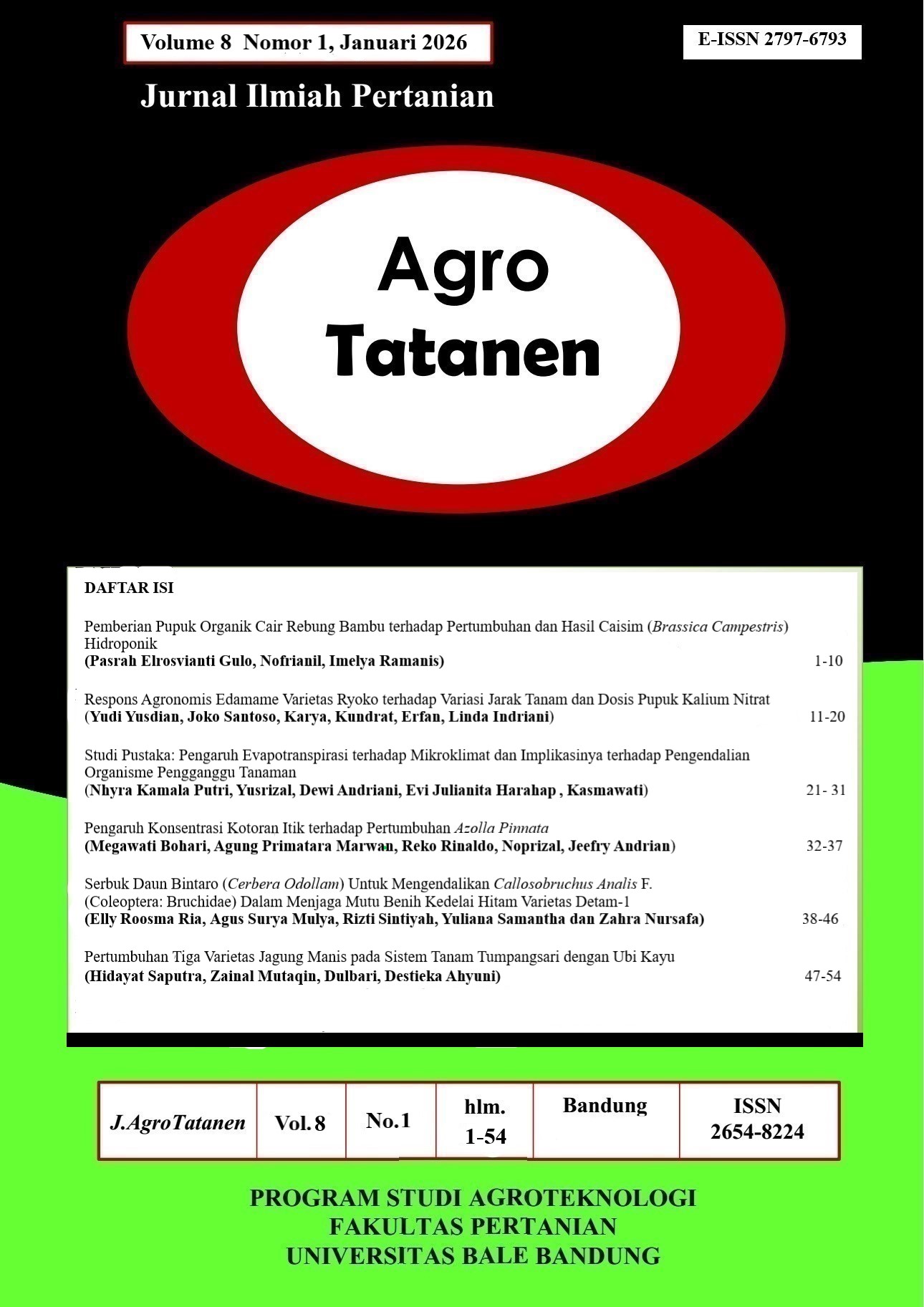
PENGARUH KONSENTRASI KOTORAN ITIK TERHADAP PERTUMBUHAN AZOLLA PINNATA
DOI:
https://doi.org/10.55222/gcenjf21Keywords:
Azolla pinnata, duck manure, photosynthesis, sustainable agriculture, nutrientAbstract
This study aimed to examine the effect of different concentrations of duck manure on the growth of Azolla pinnata and to determine the optimal concentration that promotes the best growth performance without reducing the quality of the cultivation medium. The experiment consisted of five treatments: A1 (without duck manure), A2 (20% duck manure + 80% soil), A3 (30% duck manure + 70% soil), A4 (40% duck manure + 60% soil), and A5 (50% duck manure + 50% soil), with an initial Azolla pinnata density of 200 g/m². The results showed that the application of duck manure had a highly significant effect on the growth rate of Azolla pinnata (P<0.01). Among the treatments, A3 produced the highest biomass increase, indicating the most favorable growth response. Duck manure contains essential nutrients such as nitrogen (3.40–4.42%), phosphorus (15.54–17.20%), and potassium (8.50–8.63%), which play vital roles in photosynthesis and tissue formation. These nutrients accelerate cell division and chlorophyll production, thereby enhancing the growth rate of Azolla pinnata. Compared with other organic fertilizers such as chicken, cow, or compost manure, duck manure provides higher nutrient availability and is more readily absorbed by aquatic plants. Therefore, the combination of 30% duck manure and 70% soil can be considered the optimal composition for Azolla pinnata cultivation and has strong potential to be developed as an environmentally friendly organic fertilizer within sustainable agricultural systems.
References
Bhuvaneshwari, K., & Kumar, K. (2013). Effects of organic manures on growth of Azolla pinnata. International Journal of Environmental Biology, 3(2), 45–49.
Fitriani, D., Lestari, W., & Handayani, R. (2021). Potensi pupuk organik dalam budidaya tanaman air. Jurnal Pertanian Terpadu, 8(2), 45–53.
Gasper, V. (2008). Metode Perancangan Percobaan. CV Armico.
Handayani, R., & Yusuf, R. (2022). Dampak konsentrasi pupuk organik terhadap kualitas air kolam budidaya tanaman air. Jurnal Agrohidrologi Tropika, 5(1), 30–38.
Lestari, W., Hidayat, N., & Santoso, H. (2021). Pengaruh pupuk organik terhadap pertumbuhan tanaman air dan kualitas media. Jurnal Bioteknologi Lingkungan, 3(2), 22–29.
Lingga, P., & Marsono. (2019). Petunjuk Penggunaan Pupuk. Penebar Swadaya.
Lumpkin, T. A., & Plucknett, D. L. (1982). Azolla as a green manure: Use and management in crop production. Westview Press.
Nurhidayah, R., Putra, A., & Lestari, D. (2020). Pengaruh jenis pupuk kandang terhadap pertumbuhan Azolla pinnata. Jurnal Agrosains, 22(1), 45–52.
Putra, A. R., Santoso, H., & Rahayu, L. (2020). Kandungan nutrisi kotoran unggas sebagai pupuk organik cair. Jurnal Peternakan Indonesia, 22(3), 144–151.
Rahman, A., Fitriani, N., & Yudha, S. (2021). Respon pertumbuhan Azolla pinnata terhadap kadar amonia pada media organik. Jurnal Agroekoteknologi Tropika, 10(1), 45–52.
Rahman, F., Yusuf, R., & Latif, M. (2023). Pakan fermentasi berbasis Azolla untuk meningkatkan performa unggas lokal. Jurnal Teknologi Peternakan, 9(1), 55–63.
Salisbury, F. B., & Ross, C. W. (1992). Plant Physiology. Wadsworth Publishing Company.
Sari, M., & Hidayat, N. (2022). Kandungan hara dan pertumbuhan Azolla pinnata pada media berbeda. Jurnal Agrohidrologi Tropika, 4(1), 12–20.
Setyowati, E., Suryanto, A., & Widodo, W. (2020). Pengaruh pemberian pupuk organik terhadap pertumbuhan tanaman air. Jurnal Biologi Tropika, 7(1), 45–53.
Suhartini, S., Hidayat, T., & Fitria, D. (2018a). Analisis kandungan nutrisi pada kotoran itik sebagai pupuk organik cair. Jurnal Agroteknologi, 12(2), 67–74.
Suhartini, S., Hidayat, T., & Fitria, D. (2018b). Analisis kandungan nutrisi pada kotoran itik sebagai pupuk organik cair. Jurnal Agroteknologi, 12(2), 67–74.
Supartoto, Widyasunu, P., & Rusdiyanto. (2012). EKSPLORASI POTENSI Azolla microphylla dan Lemna Polyrhizza SEBAGAI PRODUSEN BIOMAS BAHAN PUPUK HIJAU, PAKAN ITIK DAN IKAN. PROSIDING SEMINAR NASIONAL ”Pengembangan Sumber Daya Pedesaan Dan Kearifan Lokal Berkelanjutan II”, 51.
Sutanto, R. (2002). Penerapan pertanian organik. Kanisius.
Taiz, L., Zeiger, E., Moller, I. M., & Murphy, A. (2017). Plant Physiology and Development (6th ed.). Sinauer Associates.
Widowati, L. R., Sriwidodo, & Hartatik, W. (2012). Pengaruh pupuk organik terhadap sifat tanah dan produksi tanaman. Balai Penelitian Tanah.
Wulandari, E., & Sari, P. D. (2021). Respon pertumbuhan Azolla pinnata terhadap pemberian kompos organik. Jurnal Pertanian Tropika, 9(2), 112–119.
Downloads
Published
Data Availability Statement
The data generated and/or analyzed during this study are available from the corresponding author upon reasonable request.